
 +61 9555 7955
Are your leaders emotionally intelligent?
Although Emotional Intelligence (EI) is now widely acknowledged as a predictor of leadership capability, do you know what level of emotional intelligence your leaders are currently demonstrating?
We understand that emotional intelligence is talked about a lot, but it can be hard to grasp what that really means in terms of day-to-day leadership actions. Fortunately, the ability to assess and measure emotional intelligence is now well established.
Research has shown a leader’s EI can be strengthened and improved by benchmarking current capabilities across a range of scales and devising a training program that focuses on growth opportunities.

Interested in becoming an emotional intelligence expert?
The EQ-i 2.0® Emotional Intelligence Inventory is one of the foremost emotional intelligence assessments in the marketplace, trusted by organisations worldwide to measure and develop the capabilities that define effective leadership.
Become certified in the EQ-i 2.0 and gain the expertise to assess, interpret, and develop emotional intelligence in yourself and others. Whether you're building internal capability, enhancing your consulting practice, or deepening your coaching skills, EQ-i 2.0 certification equips you with evidence-based tools that drive meaningful change.
EQ-i 2.0 Sample Leadership Reports
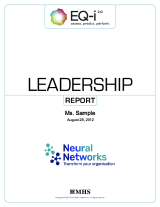
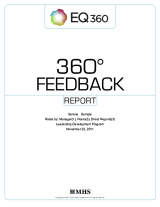
You can view a sample of the EQ-i 2.0 and EQ360 Leadership reports below.

Solutions Showcase
Solution 1 - Overwhelmed leadership team of government agency
The challenge
- Significant workload and political pressure leading to overwhelm and focus on urgent rather than important tasks.
- Need for leaders to focus on key priorities and avoid reverting to easy tasks in challenging times.
- Political spotlight on them heightened the situation.
- Director's need for a way to help leaders focus and assess their capabilities.
Our solution
- Defined role clarity to provide clear expectations and prioritise key activities.
- Mapped PSC Capability Framework against EQ-i 2.0 Emotional Intelligence assessment.
- EQ360 assessments for leaders to measure self-perception and feedback from others.
- Analysis of EQ360 results to identify capability gaps against the PSC Capability Framework.
- Design of a tailored leadership program based on analysis results.
- One-on-one coaching sessions to embed learning, contextualise it to the environment, and address mindset issues.
Solution 2 - Internal Process Improvement for financial institution
The challenge
- Lean Six Sigma initiatives identified a need for increased emotional intelligence for successful implementation.
- Desire to develop self-awareness and understanding of emotional intelligence among a large group in a short timeframe.
- Importance of understanding the impact of emotions and behaviours on others and managing emotional states.
- Need for leaders to foster inclusivity in the workplace (as a mandatory scorecard measure).
Our solution
- Unique program design with a long-term scaffolded approach.
- Phase 1: EQ360 profiling and debriefs for leaders, EQ-i 2.0 self-assessments and debriefs for team members, and a half-day workshop on building awareness and critical EI competencies.
- One-on-one coaching for leaders based on EQ360 results.
- Phase 2: Focus on embedding elements like internal capability development, a coaching framework, Master Coach program and support for building resilience and agility.
Solution 3 - Supporting Psychosocial Safety in a Disability Services Provider
The challenge
- Following a workplace incident, the Board sought to strengthen their approach to psychosocial safety and wellbeing across the organisation.
- The leadership team wanted to understand and proactively address common psychosocial hazards before they could impact their people.
- They needed practical, evidence-based solutions that could be measured and refined over time.
Our solution
- Leveraged EQ-i 2.0 profiling that had already been completed by the leadership team to provide immediate insights.
- Applied a research-backed framework that maps EQ-i 2.0 competencies against common psychosocial hazards in the workplace.
- The mapping revealed the potential for behaviours that could increase the risk of psychosocial hazards in the workplace.
- It also identified opportunities to strengthen leadership behaviours that support psychosocial safety.
- Recommendations presented for a leadership wide program together with individual targeted development to build protective behaviours and reduce potential risks.
- Established ongoing measurement using the EQ-i 2.0 profiling and the mapping framework to track progress and refine the approach.
Our emotional intelligence and leadership experience
The Neural Networks team has been assessing, training, and developing emotionally intelligent leaders for over two decades and has extensive experience providing emotional intelligence and leadership training to organisations in almost every industry.
This was an insightful leadership course that has immediate practical application.
In-house leadership program - government agency
This was frankly one of the best programs I have ever done and that I will continue to draw from and build upon. Kylie is a highly professional, skilled and experienced coach who made the learning and the thinking fun as well as hitting the spot. Thank you.
In-house leadership program - government agency
Amazing program presented by an outstanding facilitator who built the trust and rapport with each participant. Best leadership program that I have ever completed! Thank you.
Participant - Authentic Leadership Program
Frequently Asked Questions About Emotional Intelligence & Leadership
IQ (Intelligence Quotient) and EQ (Emotional Quotient) measure very different aspects of human ability — and both play important roles in how people think, behave, and succeed.
Completing the EQ-i 2.0® Emotional Intelligence Assessment is simple — and it’s one of the best ways to gain deep insight into your emotional strengths and development opportunities.
The EQ-i 2.0® and EQ360® are globally recognised, evidence-based tools that measure emotional intelligence in action.
Leaders are the most influential factor in workplace psychological safety.
EI provides the skills leaders and employees need to manage stress, build stronger relationships...
Blog Posts About Emotional Intelligence & Leadership

High-performing teams have one thing in common — people feel safe to speak up, take risks, and share ideas without fear of judgment. Yet psychological safety doesn’t happen by accident. It’s shaped every day by how leaders think, react, and relate to their people.
For leaders, these dynamics often unfold in ways that are easy to miss — subtle cues that reveal whether people feel free to contribute or careful to conform.

Gallup’s State of the World’s Emotional Health 2025 report describes emotions as “vital signs” — real-time indicators of the world’s wellbeing and stability.
When anger, sadness, or worry rise, they signal that societies — and the people within them — are under strain.
If we think about leadership through that same lens, the message is clear: emotions are the vital signs of workplace culture.
And yet, many leaders still can’t read them.

At a time when culture is everything, the cost of a poor leadership hire goes far beyond missed KPIs - it can quietly unravel trust, morale, and the sense of safety teams need to do their best work. As HR professionals and people-focused consultants, you know that leadership isn’t just about delivering results. It’s about how those results are achieved. That’s why spotting potential leadership derailers before someone is in the role is critical - not just to protect your culture, but to preserve the wellbeing of your people.

In different industries and occupations, some components of Emotional Intelligence (EI) may show up more strongly than others.
Multi-Health Systems (MHS), a globally recognised leader in scientifically validated psychological and behavioural assessments. From January 2020 to March 2022, they collected data from customers using the EQ-i 2.0® emotional intelligence assessment within specific industries. These were scored using a global professional normative sample (score of 100 represents the average score for professionals around the world).

The sales dashboard says everything’s fine.
Activity levels are high. Pipelines are full. Targets look within reach.
But one rep is stuck in a slump. Another is avoiding pricing conversations. Someone else seems to be going through the motions without much energy.
The numbers give you one version of the story. But they rarely tell you why things are happening—or not happening.
And that’s where mindset coaching comes in.
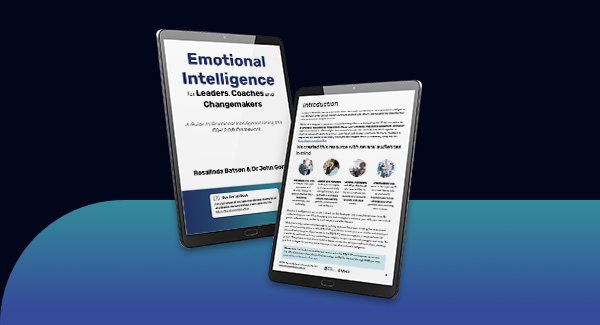
Get your free eBook introducing five pillars of emotional intelligence from the EQ-i 2.0® model-trusted by coaches, leaders, and HR professionals worldwide.