 +61 9555 7955
Working with you to craft leadership programs matched to your desired capabilities
Leadership development covers a myriad of capabilities from emotional self-awareness and state management through to influence, motivating others, understanding the reality of the landscape, curating psychological safety, change management and stakeholder engagement to name a few.
We understand how important leadership is for you and your organisation particularly when we think about curating culture. You need consistency in approach while keeping an eye on the strategy and operational imperatives.
We are hearing a lot about change fatigue and overwhelm from our clients, which makes it even more important for leaders to know how to influence and engage people to buy-in to the organisation strategy, goals and decisions as well as take care of their well-being.
If you would like us to help you develop leaders you can trust to perform how you need them to, contact us for a conversation.
Our approach to leadership development
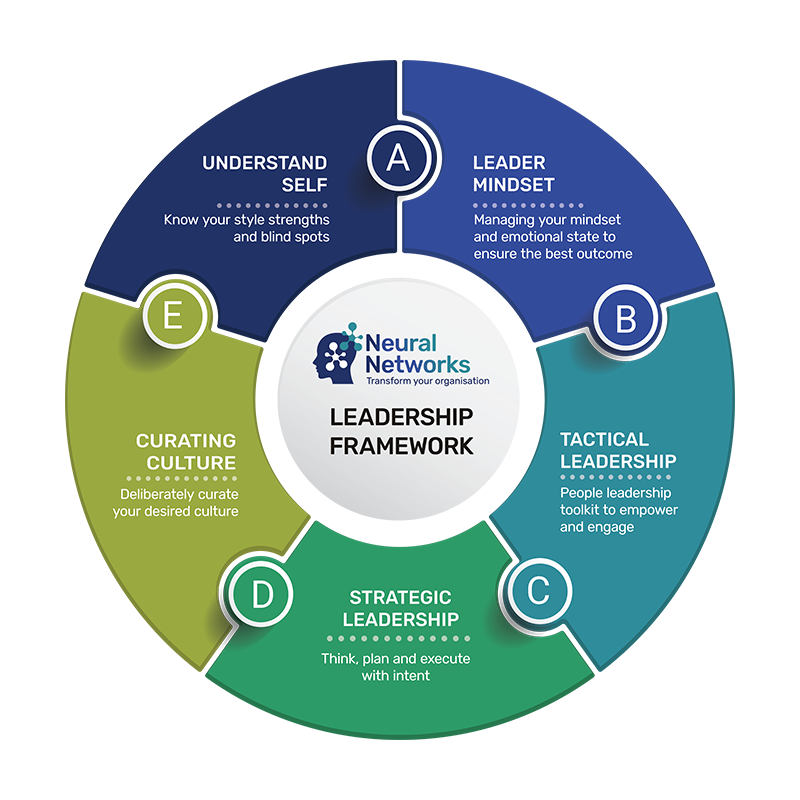
Our leadership training programs are designed to transform your leaders. By focusing on self-awareness, strategic thinking, tactical expertise, and cultural acumen, we work with your leaders to help them grow their capability.
They'll gain a deep understanding of human behaviour, be provided with a toolkit of frameworks and approaches, helping them to lead with confidence.
Our programs are underpinned by emotional intelligence and neuroscience.
Download our comprehensive brochure for detailed information on our leadership development programs.
The High Cost of Poor Leadership
Poor leaders can have a significant negative impact on your culture and the performance of your people. Some issues we have seen are:
- Lack of self-awareness impacting leadership effectiveness across multiple areas such as influence, motivation and emotional state management
- Low psychosocial safety
- Poor communication between departments negatively impacting organisation outcomes
- Favouring transaction, or getting stuff done, over connection with people resulting in a de-motivated workforce
- Poor employee engagement scores related to the perceptions of the organisation’s leadership capability
- Inconsistent leadership approach across the organisation
- Lack of clarity regarding expectations of leaders in the business
- Poor performance management resulting in less than effective work standards
If any of these resonate with you, we can work with you to design a leadership training program that meets your immediate needs and longer-term goals.
Solutions Showcase
Solution 1 - Art gallery executive team development
The challenge
- Executive team members were highly creative and passionate about the Arts.
- Working on a strategic plan for the upcoming year and seeking development in both individual and group capacities.
- Aimed to improve self-awareness in leadership styles and understand each member’s impact on overall effectiveness.
- Needed insights into each other’s strengths, skills, and priorities to better align on key strategic objectives.
- Focused on balancing priorities between altruistic goals and commercial realities.
Our solution
- Conducted individual conversations with each Executive team member to understand personal and team development needs.
- Administered EQ-i 2.0 to highlight self-perceptions of strengths and areas for growth.
- Completed EQ360 profiling to uncover potential blind spots and confirm strengths.
- Provided individual debriefs to delve deeply into the EQ-i and EQ360 reports.
- Implemented a three-month EI development plan focused on enhancing both professional and interpersonal skills.
- Offered EI support coaching sessions to address critical leadership development areas, with ‘pulse check’ sessions to maintain accountability.
- Delivered a 1-day Executive leadership workshop covering essential topics like emotional intelligence competencies, communication, influence, and shared team strengths and priorities.
Solution 2 - Senior leadership program for government service
The challenge
- The Service had undergone a comprehensive restructuring.
- Leadership team members had technical expertise but struggled with adapting to evolving user demographics and roles.
- Leadership development focused on strengthening people management and aligning behaviours with the strategic plan.
- The team managed a large workforce facing emotionally charged situations, creating a need for increased emotional self-awareness and resilience.
Our solution
- Held pre-program engagement conversations with Directors and participants.
- Aligned program expectations with the Public Service Commission Leadership Capability Framework.
- Administered EQ-i 2.0 profiling and conducted individual debriefs to identify leadership strengths and areas for development.
- Developed a comprehensive EI plan in line with the Leadership Capability Framework.
- Delivered a Directors 1-day workshop focused on building emotional self-awareness through EQ profiles.
- Ran a 3-day leadership workshop covering self-leadership, team leadership, and organisational leadership skills.
- Formed small group coaching clusters post-workshop to support application of skills and accountability.
- Scheduled progress reporting sessions with stakeholders to provide updates and discuss strategies for sustained embedding.
Solution 3 - Cultural alignment program for state government agency
The challenge
- State premier sought to evolve the agency to better support state priorities.
- Interim governance report recommended leadership modelling, talent management, and addressing underperformance.
- Sought to create a leadership culture aligned with specific attributes and capabilities.
- Psychological safety and employee motivation were highlighted as critical areas for development.
Our solution
- Conducted EQ-i 2.0 and EQ360 profiling with individual debriefs for leadership cohorts, exploring strengths and growth areas.
- Provided three additional EQ coaching sessions per leader, targeting specific areas from their reports.
- Designed a 2-day leadership and culture program aligned with the agency’s vision, emphasising capabilities and strategic priorities.
- Key components included clearing obstacles to team cohesion, fostering a strong team identity, and defining future leadership behaviours.
- Offered online modules on key topics to reinforce development long-term.
- Delivered a half-day workshop for division leaders to support coaching skills and embedding learning from the online modules.
[The Senior Leadership Program] has been such a valuable program and is really great to be in a position to apply so many of the skills. I could probably write another three pages reflecting on where I’ve become aware that I’m applying even little parts of the content... It’s gold! And seeing the impact in action give me the buzz that I love. I’m so excited to look back and see how my experience of the culture in the department shifts from viewing ourselves as separate functions, to seeing ourselves as ‘one team’ and what my role can be in shifting the culture - how powerful the program has been there!
Nicole Obermeit, Project Manager (Operations) - QLD Department of Primary Industries, Biosecurity Qld (National Fire Ants Eradication Program)
I would recommend this training to anyone who wants to develop leadership skills. Great work.
In-house leadership program - government agency
The course was excellent and Kylie a fabulous facilitator. I especially liked that she tried to apply the tools and lessons to real life... It was also a great opportunity to meet with fellow staff and understand their challenges and learn from them too.
In-house leadership program - government agency
Frequently Asked Questions About Leadership Training
Effective leadership doesn’t happen by chance—it requires intentional development and continuous learning.
Investing in a leadership development program isn’t just about developing the skills of individual leaders—it’s about creating a ripple effect that benefits the entire organisation.
The best approach often involves a combination of tools and techniques to get a well-rounded view.
Effectively assessing your team's leadership training needs enables you to make informed decisions and drive meaningful improvements in leadership performance.
We don't specialise in specific industries because leadership is a universal skill required in every business.
Blog Posts About Leadership Training

Ask most people which employees get sent on emotional intelligence training and the answer is usually senior leaders, high-potential managers, and aspiring leaders. In other words, the people whose jobs are obviously about relationships.
It's an assumption so embedded in how organisations approach learning and development that it doesn’t often get questioned, but a growing body of research - including a significant new meta-analysis published in BMC Psychology this year - suggests it's time we did.

Think about the leader you'd want coaching you through a challenging period. It would probably be someone who could sit with you in a difficult conversation without passing judgement and without trying to offer ‘fixes’. They would likely be the one that built and maintained trust with you because you could tell they were paying attention, and because they asked thoughtful questions, balancing high support with constructive challenge.

The numbers are pretty confronting. According to DDI’s Global Leadership Forecast 2025, 71% of leaders are currently experiencing elevated stress and 40% of those are actively considering leaving their roles as a result. That means leadership pipelines are thinning at exactly the moment organisations need them most.

People with high Social Responsibility can do extraordinary things. Here's how leaders can help them do even more.

High-performing teams have one thing in common — people feel safe to speak up, take risks, and share ideas without fear of judgment. Yet psychological safety doesn’t happen by accident. It’s shaped every day by how leaders think, react, and relate to their people.
For leaders, these dynamics often unfold in ways that are easy to miss — subtle cues that reveal whether people feel free to contribute or careful to conform.