 +61 9555 7955
Spotting Leadership Derailers Before They Damage Culture

At a time when culture is everything, the cost of a poor leadership hire goes far beyond missed KPIs - it can quietly unravel trust, morale, and the sense of safety teams need to do their best work.
As HR professionals and people-focused consultants, you know that leadership isn’t just about delivering results. It’s about how those results are achieved. That’s why spotting potential leadership derailers before someone is in the role is critical - not just to protect your culture, but to preserve the wellbeing of your people.
Using emotional intelligence as a lens, and specifically the EQ-i 2.0 Leadership Report, we can identify early signs of derailment that are often missed in traditional interviews or CV reviews. Below, we explore what to watch for and how to identify potential red flags in a way that aligns with a more human, values-driven approach to recruitment.
Emotional Intelligence and Leadership Effectiveness
When it comes to leadership, emotional intelligence (EI) can make or break success. Research consistently shows that strong emotional intelligence in certain areas is linked to effective leadership, while deficits in other areas can signal potential derailment. As the EQ-i 2.0 Leadership Report notes, “high levels of emotional intelligence in some areas can help predict leadership success, while low levels…can help predict leadership derailment.”
This tool goes beyond general personality measures by identifying the specific EI factors that drive leadership behaviours. For HR professionals and business leaders alike, it offers valuable insights into both leadership potential and ongoing development.
Evidence also supports the view that leaders, as a group, tend to demonstrate stronger EI skills than the general population. In one large-scale study (Stein et al., 2009), top executives scored significantly higher on 8 of the 15 EQ-i subscales. Importantly, those who displayed higher levels of empathy, self-regard, reality testing, and problem solving were also more likely to lead their companies toward stronger profitability.
In other words, EI is not a “soft skill”, it is an essential skill – it’s a measurable capability that connects directly to organisational outcomes. By assessing and developing these skills, organisations can strengthen leadership pipelines, support better decision-making, and reduce the risk of costly leadership derailments.
The Foundations of Emotionally Intelligent Leadership
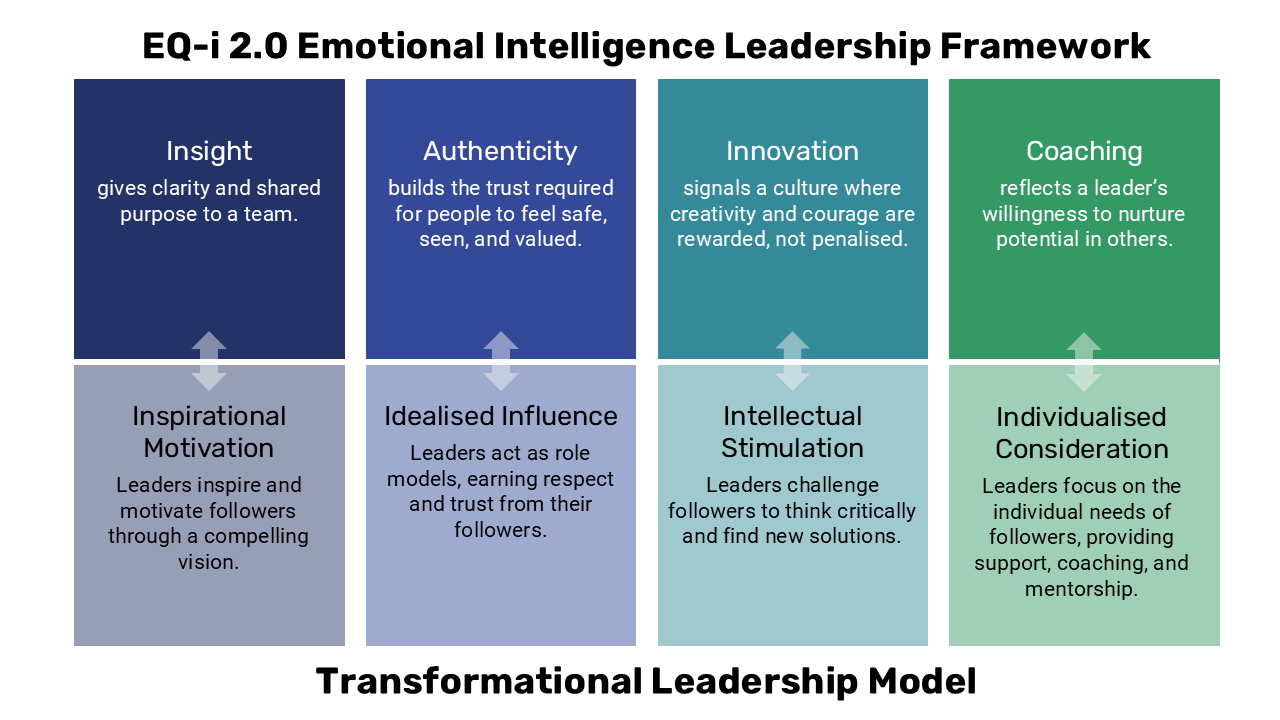
The EQ-i 2.0 emotional intelligence framework identifies four pillars of emotionally effective leadership:
Coaching, Authenticity, Insight, and Innovation.
These pillars align with the Transformational Leadership model.
-
Coaching reflects a leader’s willingness to nurture potential in others.
-
Authenticity builds the trust required for people to feel safe, seen, and valued.
-
Insight gives clarity and shared purpose to a team.
-
Innovation signals a culture where creativity and courage are rewarded, not penalised.
Four Emotional Intelligence Red Flags to Watch in Recruitment
Not all leaders fail because of a lack of technical skill or experience — many derail when they avoid responsibility, fail to act, or neglect to inspire those they lead. This “laissez-faire” style of leadership has been described as “leaders by the nature of their position, and not by their presence, ability to motivate, or positive impact they have on others.”
Research has shown that this type of non-leadership is, at best, unrelated to positive outcomes, and at worst, damaging — contributing to distress, role ambiguity, and conflict (Judge & Piccolo, 2004; Skogstad et al., 2007).
The EQ-i 2.0 offers valuable insight here. Studies show strong negative correlations between emotional intelligence and laissez-faire leadership. In other words, as EI increases, the risk of avoiding leadership responsibilities decreases. The correlations are significant, ranging from -.50 for Problem Solving to -.20 for Empathy and Social Responsibility.
So what does this mean for leadership development? Leaders with lower scores in certain EI subscales are less likely to be visionary, inspirational, or innovative — and more likely to slip into avoidance behaviours. To highlight this risk, the EQ-i 2.0 Leadership Report identifies four subscales most strongly connected to derailment risk:
- Impulse Control
- Stress Tolerance
- Problem Solving
- Independence
Focusing development on these areas can help leaders stay engaged, accountable, and effective — reducing the risk of falling into a pattern of avoidance that undermines their impact.
Specifically here is how they may show up.
1. Impulse Control
The ability to pause before acting is essential in leadership. Low impulse control often reveals itself in rushed decisions, reactive communication, or a struggle to truly listen.
💬 In interviews, this might show up as interrupting, long-winded or circular answers, or not responding directly to questions.
🔎 Why it matters:
Leaders who act without reflection can destabilise teams and erode psychological safety.
2. Stress Tolerance
Leaders who cope poorly with stress can unintentionally spread anxiety, creating reactivity instead of calm.
💬 In recruitment, this could look like overexplaining, nervous energy, trying to control the interview format, or repeated contact outside of agreed communication channels.
🔎 Why it matters:
High-pressure moments reveal a leader’s emotional climate. Will they steady the team—or contribute to the chaos?
3. Problem Solving
EI-based problem solving is not just about finding answers—it’s about how solutions are reached in emotionally charged or ambiguous situations.
💬 In assessment, look for candidates who focus only on the outcome, not the process. If they can’t describe their method or tend to default to ‘what the organisation did’ rather than their own contribution, it may suggest gaps in emotional reasoning.
🔎 Why it matters:
Leaders who don’t engage others in problem-solving can inadvertently shut down collaboration and innovation.
4. Independence
Healthy independence allows a leader to act with confidence—but without ego or disconnection.
💬 In conversation, extremes might show as an overemphasis on personal autonomy or, conversely, constant referencing of the group, without personal ownership.
🔎 Why it matters:
Too much independence can isolate leaders. Too little can create dependency or people-pleasing, which undermines decision-making and balance.
Why This Matters More Than Ever
We’re seeing a shift: from purely skills-based hiring to hiring for emotional impact. With the rise of hybrid work, growing awareness around psychosocial safety, and the war for leadership talent, hiring decisions now carry even greater weight.
Organisations are being held to higher standards—not only for results, but for how their culture nurtures wellbeing, belonging, and purpose. Leaders with emotional intelligence are better equipped to foster this kind of environment.
That’s why tools like the EQ-i 2.0 are becoming indispensable in the recruitment process. They allow us to move past surface impressions and uncover the emotional competencies that build—or break—culture.
A Final Word
For those of us working in people and culture, leadership decisions are never just operational—they’re deeply human. Every leader we place will influence someone’s day, someone’s development, someone’s confidence.
Let’s keep lifting the bar. Let’s keep hiring for who people are, not just what they’ve done.
Warm regards,
The Neural Networks Team
📄 Download a Sample EQ-i 2.0 Leadership Report - https://www.neuralnetworks.com.au/uploads/877/17/EQ-i-2.0_Leadership_Sample_Report.pdf
🔍 Interested in integrating EQ into your recruitment processes? We’re here to help.
Sign up for the Neural Networks Newsletter
Join our mailing list to receive information on leadership, sales, and emotional intelligence.