 +61 9555 7955
The Leadership Skill People Often Confuse with Aggression

Why the most psychologically safe teams are led by people who say hard things clearly, calmly, and without apology.
Some of the most psychologically safe teams we come across are led by people who are remarkably direct. They’re not loud or harsh, but they are willing to deliver a tough message, clearly, in the moment.
That's not always where leaders land, though, and it's easy to see why. Many have been taught, quite rightly, that good leadership means listening more, delivering feedback with care, and building consensus. There's also a newer layer to navigate - psychosocial hazard legislation - which now asks organisations to actively manage things like poor workplace relationships and unreasonable demands, with the same rigour as a physical safety risk. We think that’s a genuinely positive shift for workplace wellbeing. It has also left some leaders wondering how directly they're still allowed to speak.
Which makes this a great moment to get curious about what Assertiveness actually is (and isn't) because the leaders who are navigating this well aren't the ones who say less, they're the ones who've learned how to say things in a way that lands well for everyone.
Assertiveness is one of the more misunderstood subscales in the EQ-i 2.0 model. It’s also one that's become especially relevant as leaders try to reconcile building psychological safety, and remaining compliant with legislation, with being direct – all in the same breath.
It’s worth pausing on the word itself before we go any further, too. In everyday conversation, “assertive” often gets used loosely, sometimes as a polite stand-in for “pushy” or “domineering.” That casual meaning is important to set aside here, because the EQ-i 2.0 defines Assertiveness far more precisely, and considerably more positively, than everyday usage suggests.
What the EQ-i 2.0 Actually Means by Assertiveness
Assertiveness sits in the EQ-i 2.0's Self-Expression composite, alongside Emotional Expression and Independence. Here's how the technical manual defines it.
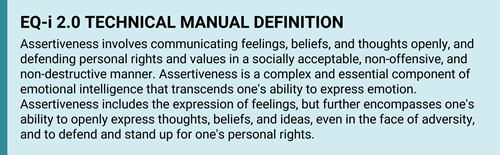
Take your time reading that definition, because the phrase doing the real work is socially acceptable, non-offensive, and non-destructive manner. Assertiveness in the EQ-i model has never been about being loud, forceful, or the first to speak. It's about the ability to deliver a truth without hurting the person you're saying it to, and without hurting yourself by staying quiet.
That distinction makes a difference, because in our experience, most leaders don't actually have an aggression problem. They have an under-assertion problem that they've mistaken for good manners.
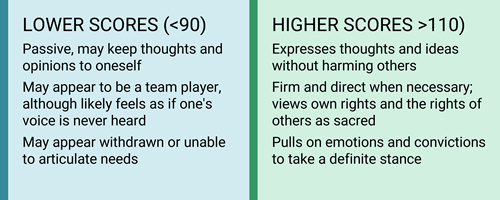
Here's what the two ends of the spectrum tend to look like in practice.
What Speaking Up Builds
There's a substantial body of research on what organisational psychologists call employee voice and silence (the conditions under which people choose to speak up or stay quiet). A recent decade-in-review of that literature identifies two consistent drivers of silence:
- a belief that speaking up is futile (it won't change anything), and
- a sense that speaking up is risky (it will be held against you).
But they also found that, when people believe speaking up will actually lead somewhere, they do it far more readily. Individual traits including assertiveness are, unsurprisingly, one of the strongest predictors of who's willing to go first.
That's important to remember as a leader, because you go first constantly. Every time you name something clearly and follow through on it, you're showing your team that voicing a concern is worth the effort. One of the most direct ways to build the psychological safety everyone's trying to create is not by staying quiet, but by demonstrating, again and again, that clarity is welcome here.
When Assertiveness Can Look Like Aggression
It would be easy to walk away from this thinking high Assertiveness is risky, but it isn't, and the good news is the EQ-i 2.0 has already built the reassurance into the construct itself. Look back at the definition: it specifies expressing yourself “in a socially acceptable, non-offensive, and non-destructive manner.” A high score on Assertiveness, as the model measures it, is by definition not the same thing as being aggressive. They're different constructs that happen to share a description in everyday language.
What can create discomfort is Assertiveness operating without its natural partners, the most important of which are Empathy and Impulse Control, with Interpersonal Relationships playing a supporting role. It's a great example of one of the EQ-i 2.0's core ideas: no subscale tells the full story on its own. It's the combination of scores across the model that shows how a strength shows up in someone's behaviour.
| Assertiveness + Empathy | Firm and attuned – able to deliver hard messages and read its impact on the other person as it lands. |
| Assertiveness + Impulse Control | Direct without reactivity - chooses the moment and the words, rather than firing from emotion. |
| Assertiveness, low Empathy and/or low Impulse Control | Reads as aggression to the people on the receiving end - regardless of what the Assertiveness score alone says. |
So, when landmark research by Columbia Business School's Daniel Ames and Stanford's Frank Flynn finds that leaders perceived as "too assertive" are rated as less effective, it's a great prompt for curiosity rather than alarm. In most cases, what raters are picking up on isn't high Assertiveness in the EQ-i sense at all, it's Assertiveness without the Empathy or Impulse Control that would have rounded it out. That's good news because it means the answer was never to dial Assertiveness down, but to build the combination.
The finding that matters most for this newsletter is the shape of the underlying pattern the researchers uncovered. It isn't a straight line where more is always better, and it isn't a case for less, either. It's a reminder that Assertiveness is a strength best read alongside its neighbours and that leaders who invest in the full combination tend to be experienced as both direct and easy to work with. You can read the full study breakdown, including how the researchers measured this, in this month's Study Spotlight.
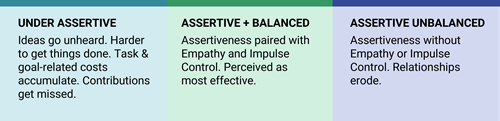
Conceptual illustration. The right-hand zone isn't “high EQ-i Assertiveness” it's assertive behaviour uncoupled from Empathy and Impulse Control (see Study Spotlight below).

What This Means for Your Next Challenging Conversation
Separate the observation from the verdict. Assertiveness is about expressing what you've noticed and what you believe, not delivering a final judgement. “This has missed deadline three times” is assertive. “You clearly don't care about this project” is not.
Use language that owns the feeling. The EQ-i pairs Assertiveness with Emotional Expression for a reason. Naming what you feel (“I'm concerned about...”) keeps the exchange grounded in your own experience rather than an accusation about theirs.
Hold both sets of rights as sacred. The technical manual's language is specific here: assertive people view their own rights and the rights of others as sacred. If a conversation only protects your comfort or only protects theirs, it isn't yet assertive, it's either avoidance or dominance wearing assertiveness as a disguise.
Pair the message with a check on its impact. This is Assertiveness working alongside Empathy, not instead of it. Deliver the message clearly and then pause to read how it landed, rather than moving straight on to the next point. That pause is often the difference between firm and forceful.
Reflection
FOR LEADERS
- Think of a recent moment you held something back. What did you tell yourself was the reason — and was it really true?
- Where do you generally sit on the spectrum between passive and forceful, and has that shifted under pressure?
- What's one conversation you're currently avoiding, and what would it look like to have it, being firm, direct, and without collateral damage?
The goal isn't leadership without discomfort, since a hard conversation handled well is still hard. The goal is a leader who can tell the difference between kindness and avoidance, and who trusts that delivering the message well, is one of the most respectful things they can offer a team.
That is what the EQ-i Assertiveness subscale, developed well, makes possible. It's an energising skill to build because getting it right tends to feel like a relief for everyone in the room.
Sign up for the Neural Networks Newsletter
Join our mailing list to receive information on leadership, sales, and emotional intelligence.